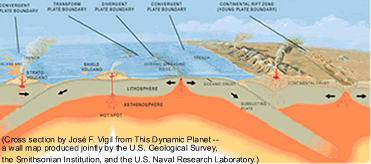
| The earths crust is split into large rigid slabs of rock called tectonic plates. The slabs are the cooled outer layer of the earth and beneath them the lies the mantle, a very hot layer of rock on which the plates float. The plates move over the mantle because of convection currents caused by heat from the earths core.Where the plates butt up against each other, at a plate margin volcanoes and earthquakes occur. |
|
| Where oceanic crust is destroyed. When cold dense oceanic crust converges with less dense oceanic or continetal crust;sinks back down into the mantle at a trench and is reincorporated into the mantle. Mantle convection currents combine with slab pull to keep the plate moving downwards.This can form a destructive boundary 1000km s long. A pattern of earthquakes with increasing depth follos the descending slab- Benioff zone. As the plate descends it takes sea sediments with it or scrapes them off as an accretionnary prism. The sediments and minerals in the slab release fluids which cause the mantle above to melt and magma to rise to the surface. Where it erupts it forms a volcano. |
|
| Where new crust is created. A long ridge of submarine volcanoes which erupt to form new oceanic crust and cause the oceans to widen. The ridge forms a plate boundary and the basalt lava which erupts spreads outwards from the ridge to form the new ocean floor. As the lava erupts the iron bearing minerals are aligned with the earths magnetic poles allowing age and magnetic reversals to be plotted. On land a constructive margin starts as a rift with volcanoes which if successful can split apart a continent to form a new oceanic. |
|
| A hot jet or column of mantle which rises up from deep within the earth, spreads out below the crust and pierces it to form volcanoes. The plume remains stationary as the plates move over the top .Exact cause is not known. Chains of volcanoes occur where the plume pierces oceanic crust eg. Hawaii and on land vast flood basalts and supervolcanoes can occur eg Yellowstone. |
|
| A 2900km thick layer of the earths structure between the core and the crust. The boundary of the crst and mantle is called the MOHO. The mantle has two main layers the upper and lower mantle. With the earths crust the very top of the uppermantle forms the Lithosphere which is around 200km thick. The upper mantle is at temperatures of 500-900C but the rocks are solid due to the pressure they are under.However the mantle is said to be "plastic" in nature can flow -like warm plasticine. The main rock type is called peridotite which mainly consists of the minerals olivine and pyroxene. MORB is a direct product of the mantle and has a high olivine and pyroxene content. |
|
| Within the mantle convection currents occur caused by the enormous amount of heat given out from the earths core. Although the mantle is solid it can flow due its" plastic" nature. Convection currents push and pull the tectonic plates over the mantle causing continents to collide and subduction zones. |
|
| Oceanic crust is formed at constructive margins or mid ocean spreading ridges and is around 10km thick.It last around 200ma before being subducted. It is mafic in composition which means its direct origins are from the mantle and is very high in iron and magnesian.Ths mafic melt forms two main rock types MORB or mid-ocean ridge basalt, which erupts from the spreading ridge volcanoes and gabbro which is the crystalline version of basalt formed in the magma chamber below the ridge. It is very difficult to research the ridge , submarines and seismic surveys being the main tools. However fragments called Ophiolites ,which have been scraped off onto the surface during collision, have helped geologists stay dry and still look at oceanic crust. |
|
| Where two continental sections of crust collide. Neither can be subducted but one is generally thrust under the other forming impressive mountain ranges such as the Alps and Himalayas. The mountains are made from the marine sediments which once lay between the continents prior to collision. | |
| Where two plates slide past each other in opposite directions. The boundary is called a strike slip fault or transform boundary. The movement is not smooth and enormous tension is stored along the fault until it releases suddenly. This sudden release of energy forms ripples throught eh earths crust called seismic waves or earthquakes. There are no volcanoes along this kind of boundary. |
|
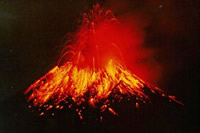
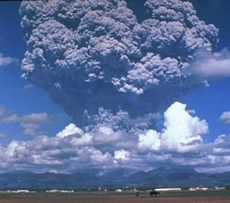
| Usually found at a destructive plate margin stratovolcanoes erupt explosively. Viscous lava, ash,tephra and pyroclastic flows build up a steep sided cone with a crater(s) at the summit. The voclano can erupt a variety of lava types from black basalt, through andsite and sticky dacite to the eruptive equivalent of granite- rhyolite. This variety of lavas is due to cooling and crystallisation of the magma within the volcano changing the composition of the melt when it is erupted. The volcano may have smaller parasitic cones. Domes of lava may form in the summit craters. |
|
| Shield volcanoes have gentle slopes and large diameters. They are formed by the accumulation of low viscosity basalt lava flows. Because the flows have low viscousity they flow a long way. Lava tubes form which enable molten lava to flow long distances from the vent. They form where large volumes of basalt lava are erupted over along period of time from one location such as over a hot spot/mantle plume. They are called shield volcanoes because they look like a warriors shield. |
|
| Lava domes are composed of highly viscous lavas with high silica contents such as dacite or rhyolite. They are typically found in the craters of stratovolcanoes such as Mt.St. Helens or Soufriere Hills. The lava is exuded rather than erupted and is squeezed out like thick toothpaste. If they become unstable and collapse pyroclastic flows can be produced or tall eruption clouds. | |
| Cinder cones are compsed of rock fragments whcih have been ejected from a vent possibly as molten lava , cooled on hteir descent and droped downwind of a volcanic vent. Often made of scoria and tephra ( small volcanic rock fragments) they from quickly perhaps over a few days. They can 100 of metres tall. The rock fragments are cooled quickly and glassy in texture. They require low viscosity lava to form such as basalt. | |
| A supervolcano usually forms over a hot spot and under thick crust. They often appear on the surface as a large depression called a caldera which can be 10 s of km across. The depression is sometimes filled with a lake as at Taupo. The caldera is formed as the magma inside is violently blown out of the magma chamber below. Initially this is from the edges then the whole caldera floor collapses, leaving a flat bottomed depression surrounded by steep sides. The map shows the track of the Yellowstone hot spot. discovery.com Discovery Channel Supervolcano Yellowstone |
|
| Fissures and rifts are elongate cracks in the earths surface.Fissures are smaller than rifts. They typically form where the crust is under tension and is pulled apart allowing molten rock to pour out. Basalt is the predominate rock type found and fountains or curtains of "fire" can spectacularly erupt. Eruptions can pour out large volumes of basalt and eventually focus on one or two main vents. | |
| A reservoir of magma beneath an eruptive crater,vent or centre. Can either be a large volume of liquid or an area of fractured rock. Convection currents occur . Fractional crystallisation can occur where lighter minerals crystallise first and float to the top.If the chamber cools and solidifies full then large crystals will from. If it is dramatically evacuated then it may collpases to form a caldera. | |
| Found where large amounts of magma have been supplied to near surface magma chmaber. If the volcano dramatially erupts and the chamber is explosively evacuated then the roof of the chamber will collapse forming a caldera. An often rouded depression with a flat bttom and steep cliff sides will be left. A lake or sea may fill the depression. | |
| Where rainwater or groundwater comes into contact with hot rocks below the surface and is heated. The water rises to the surface through fractures and cracks. Hot springs,geysers and fumaroles (small outlets of steam and gas). The water may have a high mineral content and be acidic due to dissolved gases such as sulphur dioxide. Rocks can be corroded and crumble in hydrothermal areas. On the plus side natural Spas are often in hydrothermal areas. | |
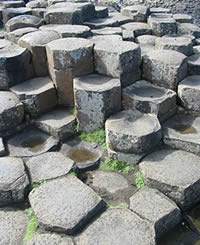
| Basalt is a mafic extrusive rock derived from partial melting of the mantle. It is commonly found as the uppermost layer of oceanic crust. It largley consists of fine grained crystals of olivine,feldspar and pyroxene with other accessory minerals. It may contain gas bubbles filled with other minerals or porphry minerlas which are larger crystals formed in the magma. It is usually black with small gas bubbles. Under water basalt forms pillow lavas when it pushes out elongate pillow shapes of lava around which a chilled skin forms on contact with cold sea water. As more lava arrives then the pillow bursts and the new outer skin is cooled. On land basalt forms long fluid lava flows or high fountains of glowing lava. Columnar basalt can form if the lava flow is thick enough. Polyganol columns of lava which look man made almost. Found in most volcanic areas but mainly in areas where a constructive ridge breaks the surface, rifting is occuring or hot spot activity. Can be found in Destructive margin setting. |
|
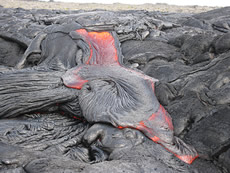
| Pahoehoe is an Hawaiian word which means smooth or rope like.Pahoe hoe lava is composed of basalt ,is very fluid and has a temperature of 1200C. The ropey surface texture takes the form of nestling loops of lava. Pahoehoe flows quickly and forms lava flows which can run for miles within roofed over lava tubes. Lava tubes form when the edges of the flow cool and form a channel, eventually the channel roofs over and the lava carries on flowing until it runs out leaving an empty tube. |
|
| Aa aa lava is a basaltic lava but at a lower temperaure than Pahoehoe at around 1000C. The lower temperature means that it is more viscous and flows as a blocky lava flow consisting of blocks called clinker. It moves slowly and creeps forward the top of the flow falling over the front face. The core of the flow is a paste like thick lava. Once cooled the surface is very rough and treachorous to walk on. | |
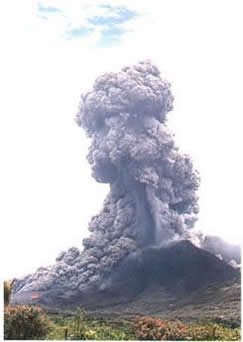
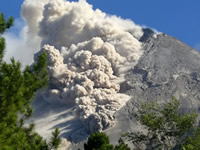
| Pyroclastic means" fire of broken rocks".Nuee Ardente is the French version. The flow appears as a billowing grey cloud moving at great speed down the slopes of a volcano. They consist of hot ash,rocks,dust and gas at a temperature of 100OC and can move at speeds of up to 100km/hour. The grey cloud is the cooled exterior of the cloud and thermam imaging equipment would show them to be very hot. Dome collapse and eruption colomn collapse are the main causes. They can even travel across water. Vesuvius, Soufriere Hills.Mt.Pelee and Mt.St.Helens all produce Pyroclastic flows. |
|
| A lahar is a volcanic mudflow consisting of fast flowing mixture of volcanic debris and water. The flow has the consistency of cement and once it drys out is very hard. They form where water from a craterlake,melted glacier, river or heavyrain mixes with either new eruption material or old ash deposits. Lahars can either be hot or cold. They can travel great distances along existing valleys far from their original source. | |
| There are three types of rock Igneous:from magma Sedimentary the surface products of erosion and weathering Metamorphic : altered rocks due to high temperatures and pressures Here we will just look at Igneous rocks. Igneous rocks can be classified under the following criteria. Extrusive/Volcanic Instrusive/Plutonic Texture/crystal size Chemical composition The chemical composition of magmas will determime which minerals are present. Magmas more rich in iron and magnesian are called basic melts, magma with more silica felsic or acid. If a magma is stats to cool within the crust then crystals will grow until the magma is gone and get large. If the the magma is erupted then the crystals don't have time to grow, the lava cools quickly and the "grain size" will be finer. Therefore the same melt can produce different looking rocks but with the same composition. eg. basalt is the igneous form of basalt, and granite the igneous form of volcanic rhyolite. |
|
| Volcanic bombs occur where "blobs" of molten lava are ejected through the air. As they fly through the air they may become streamlined. Bombs( 6.5cm or bigger)can be from 10cms to metres across and can be ejected several km from a crater. Types Ribbon,spherical,spindle,cowdung,breadcrust and cored. Cow dung bombs are still liquid when they hit the ground and splat into a flat shape on impact. Breadcrust bombs have a cracked crust like loaf of bread, this occurs where the inside continues to expand after the outside as cooled. |
|
| All volcanoes emit gases. The most common gas is water vapour followed by carbon dioxide and sulphur dioxide. The rate of sulphur dioxide emmision is an indicator of volcanic activity levels. Sulphur dioxide high in the atmosphere has a cooling effect on the earth. Carbon dioxide has a warming effect and is a greenhouse gas. Volcanoes probably supplied the earth with its initial atmosphere, warming the environment enough that life could survive. If magma is fluid then gas can easily escape, such as basalt. If magma is more viscous then gas cannot so easily escape and may be released violently. Volcanoes emit many other gas including the Noble gases,chlorine,methane,CO and hydrogen. |
|
| Occur where rising magma meets with groundwater and instant evaporation and consequent expansion to water vapour occurs. Violent explosions and eruptions follow which disentegrate the lava and surrounding rocks. | |
| Continental crust is composed of silica rich minerals and has a largely granitic compostion( quartz,feldspars,micas) it also includes surface sediments and metamorphic rocks. It is typically 35-40km thick but can be thicker in mountain ranges and thinner in areas of extension. It is very bouyant and forms the main land masses. Continental crust along with oceanic crust forms the earths plates and the movement of the plates carries the continents around the surface of the earth.As it is so bouyant it is difficult to destroy and some sections of the crust are incredibly old up to 4 billion years old, from a period called the Archaen - Precambrian. Opposite is Half dome, in Yosemite National Park USA. Within this photo all you can see is granite the main constituent of continental crust. Granite is formed in destructive and collisional settings. It does not erupt but rises as plutons ( huge blobs shaped like balloons) of magma which rise through and consume the crust above. |
| Home |
|---|
| Webcams |
| Shop |
| Contact us |
| Featured Volcanoes |
If you like the site why not link to us
Need help with this just contact us.
Volcanic Information |
|
| Travel | All About Volcanoes |
| Volcanic trips, tours and treks | Types of volcano |
| What to take | Picture Glossary |
| Travelogues | Plate Tectonics |
| Contact us | News/Activity Updates |
![]() |
![]() |
![]() |
![]() |
|
Hawaii |
Yellowstone Supervolcano | Mt .Etna Europes largest volcano |
Mt.St.Helens Washington USA |
Stromboli Lighthouse of The Med. |