Advnture Travel Hut: Your Gateway to Adventure
Adventure travel hut
Worldwide adventure gateway, + gear,books and destination profiles

New Zealand Geology bit EXTRA
SCROLL DOWN FOR TAUPO VOLCANIC ZONE
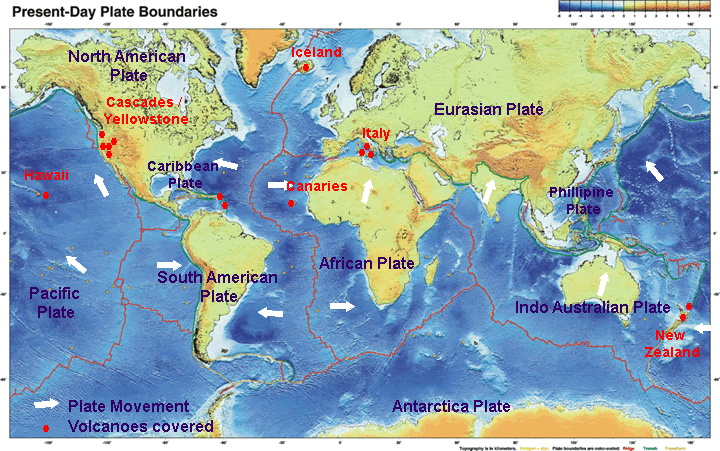
New Zealand owes its existence to Geological turmoil. The North Island has seen numerous volcanic episodes caused by the subduction of the Pacific plate beneath the Australian plate. As the more dense oceanic crust sinks beneath the Australian plate fluids are released from the descending plate which aids melting of the mantle wedge above. The key to understanding current activity Current Volcanic activity is within the Taupo volcanic zone.

North Island actually sits on the Australian plate and South Island mostly on the Pacific plate. The New Zealand we see above the surface of the sea is part of a fragment of continental crust which was originally attached to Australia. The Kermadec Trench off New Zealands East coast marks the destructive boundary between the Australian and Pacific plates where the Pacific plate sinks beneath the overlying Australian plate at about 40mm/year. In South Island the boundary changes to a Conservative or Strike slip boundary along the Alpine fault where the plates slowly grind past each other. This movement has thrust up the mountains of South Island.

www.teara.govt.nz:Geological Background of New Zealand
Global volcanism project:New Zealand


The Taupo Volcanic zone TVZ is an extensional feature called a back arc basin which allows magma from the mantle to well up near the crust causing more activity. The basin has formed to the east of the subduction zone and is caused by the extension of the crust above the subduction zone. The extension has created two types of volcanism Dacitic/Andesitic/Basaltic traditional cone volcanoes and Rhyolitic Calderas which have produced over 90% of the volcanic material.

Rising magma can come more silica rich as it is contaminated by the overlying continental crust on its ascent and secondly if the magma is collected in an underground reservoir or magma chamber the more silica rich mineras such and quartz and feldspar will crystallise first- fractional crystallisation.

Both of these procesess will result in a more sticky, high silica magma which is more sticky. Andesite magmas such as at White Island have sightly less silica in than Rhyolite magmas as at Tarawera, add gases and steam to either and you have an explosive mix.Where magma comes more directly it tends to be more basaltic,lower in silica and higher in iron ,as at Tarawera and Aukland.

The Calderas hide super volcanoes and have filled with water to form large lakes such as Taupo and Rotorua. Their larger eruptions would have an impact on a global scale and make the the smaller eruptions of White Island and Tarawera seem like an annoying firework!


There have been several phases of volcanic activity on North Island and there are numerous extinct and dormant volcanoes all over.

Waitakere ranges (25-15 million)
Northland volcanic field (10 million years-60,000)
Auckland Volcanic Field, 48 small basaltic volcanoes( 140,000 to 600)
Coromandel and Hauraki Volcanic Region(18-4 million)
Waikato basaltic and andesitic strato-volcanoes(2.7-1.6 million)
Egmont volcanoes (1.75 million),including Mt. Egmont and Mt.Taranaki(1755 AD).


www.teara.govt.nz: New Zealands volcanoes
Volcanoworld: Rotorura
wikipedea: Taupo Volcanic Zone
GNS: Volcanoes of New Zealand
Volcano world:Taupo Volcanic Zone

Recommended walking peak bagging site
www.peakbagging.co.nz

To the top / Uk shop / USA shop
Ruapehu

Mt.Ruapehu lies within Tongariro National Park, a world heritage site,along with two other large volcanoes Mount Ngauruhoe and Mount Tongariro. The volcanoes are within the 2 million year old Taupo volcanic zone and Ruapehu marks its south western boundary. Ruapehu is New Zealands most active and largest volcano and the its triple summit is the highest point on North Island. Ruapehu is home to North Islands ski slopes and only glaciers. Ruapehu is Maori for "exploding pit" .

GNS:Volcano Webcams

The Geology Bit
The volcano has three peaks Tahurangi (2797m),Te Heuheu (2755m) and Paretaitonga (2751m) with the active crater nestling between them. There is a crater lake at the summit which can contain up to 10 million cubic meters of acidic water.

In 1945 and 1995 the volcano ejected the water out of the crater onto the glaciated slopes. Lahars flow from the summit and and are a great hazard and have occured throughout the volcanoes history.Major eruptions are roughly every 50 years with 60 minor eruptions since 1945

Ruapehu is an andesitic stratovolcano and consists of andesite lavas and debris which have accumulated over the past 300,000 years. The volcano sits above a subduction zone or destructive boundary within the extensional basin of the Taupo Volcanic Zone caused by the the subduction of the Pacific plate in an easterly direction beneath the Indo-Australian plate. The decending slab of cold and dense Pacific Oceanic crust releases fluids which aids melting of the mantle wedge above. The magma then rises to the surface through weaknesses and cracks in the crust above and erupts as a volcano. The Extension of the crust in the TVZ allows the magma to well up in large amounts and break through the thin crust or pond ust below it.

Volcanoworld: Taupo Volcanic Zone

Chistmas Eve lahar 1953: Tangiwai Disaster
On Chistmas Eve 1953 the tephra dam holding the crater lake back collapsed and a lahar rushed down the Whangaehu river. The lahar washed out the Tangiwai bridge just before an express train ran through. The driver was unable to stop the rain in time and 6 carriages plunged into the river killing 151 people.

1995-1996 eruptions
The eruptions of Ruapehu made the global headlines when skiiers were pictured on Ruapehus slopes with an eruption cloud behind. The volcano had been rumbling since November 1994 and the crater was warming up. Lahars flowed down the Whangaeu river during september 1995.

2006
Eruption sends water column 200m into the air.

2007 March 18
The tephra dam to the crater lake bursts and lahars flow down the Whangeahu river. 1.4 millon cubic metres of material. Road and rail were severely disrupted for a day. No one was hurt.
On September 25 a sudden phreatic eruption injured a teacher who was in the summit area when a rock landed on his leg. Lahars travelled down the mountain.

In September 2007 the summit area was closed to visitors so it is vital to check the status of the volcano.
www.teara.govt.nz:Geological Background of New Zealand
www.Geonet.org.nz Webcam
www.Geonet.org.nz Level of activity updates
www.Geonet.org.nz Ruapehu
ww.natureandco.com: Volcanoes in New Zealand

What to see and how to see it.

Ruapehu lies within Tongariro National Park, 40km SW of the southern shore of Lake Taupo. It is possible to stay on the shores of Lake Taupo and go to Ruapehu for the day. You can also make National Park Village at the base of the volcano your base. The volcano has two ski areas, Whakpapa and Turoa which provide accommodation, services and lifts up to. The park is named after the Tongariro volcanic complex which inlcudes Mt. Tongariro and Mt. Ngauruhoe which featured in The Lord of the Rings.

Reccomended site
www.peakbagging.co.nz Mt_Ruapehu

www.mtruapehu.com : Skiing and much more
www.snow.co.nz
Bayview Chateau Tongariro
www.metservice.co.nz : Ski and snow reports

Crater Climb
The crater area is potentially a highly explosive area and therefore no ascent to the crater should be made if the authorities have closed the summit. Check the links above for access information. The Whakakpapa Visitor Centre will provide route conditions and activity updates. Check before you set out. If the chairlifts are not running its unliklely that the volcano can be safely climbed!

www.Geonet.org.nz Ruapehu

When the summit is open and safe the best time to climb is in the summer.Winter ascents require alpine climbing experience and equipment. As the slopes of Ruapehu are home to the Whakapana Ski Area you can make use of two chairlifts up to 2020m to the Knoll Ridge Chalet from Iwikau Village. The round route from the top of the ski lift takes about 5 hours and is 7km. If you want to ascend all the way by leg power its 10km and takes about 7 hours from the top of the Bruce road. The route to the crater is not marked, so it might be wise to go on an organised ascent with a guide if you are inexperienced.

Dome Ridge can be icy and narrow and should not be attempted without the proper equipment if there is ice present.

Route 1
Ascend to Knoll Ridge Chalet ( New Zealands highest cafe) and follow the t-bar line up to the last pylon. At the end of the valley climb upwards to behind Glacier Knob. Follow a zig zag path up onto Dome ridge and onwards to Dome Shelter.

Route 2
Best attempted when there is very little snow. Take the Waterfall Express chairlift and bear right from the top over towards Restful Ridge. Follow the rocky ridge towards towards the crater. At the end of the ridge follow a zig zag trail up to Dome ridge and then up to Dome Shelter.

Ruapehu is a very active volcano which can suddenly erupt. The weather can change quickly and it may be icy. The volcano will still be there tommorrow!!!

Other Actiivities

Tongariro Crossing
A one day trek (8-9hours) through across a dramatic volcanic landsape, one of the best day walks in New Zealnd. Start out from National Park Village. If you are feeling fit you can climb Mt. Ngauruhoe or Mt.Tongariro. You will need to be shuttled from the start and end of the track .

Take adequate warm and waterproof clothing. Food,water and a map. Don't attempt the walk in poor weather or alone. Assess your fitness and experience and take advice.

www.tonarirocrossing.org.nz : All you need to know
www.thetongarirocrosing.co.uk : Organised Hikes
www.tongarirocrossing.com : Shuttle bus comapny

www.natureandco.co.uk : Virtual tour of the walk

Links
www.visitruapehu.com:Onestop guide,accomodation,activities
www.newzealandtravelplanner.com
Global volcanism project

To the top / Uk shop / USA shop


New Zealand satellite image NASA

Simmons,Brown and Braithwaite (1992). Ruapehu Lake Taupo Rotorura Tarawera White Island


Ruapehu USGS


Ruapehu wwwistockphoto.com / Graeme knox


Mt.Ngauruhoe/www.istock.com/Yvette Sandham


Mt . Ngauruhoe / www.istockphoto.com / Ira Ovchinnikoa


Tuora Ski field Pseudopanax


Ruapehu pole doctor

Emerald Lakes Tongariro Crossing Yodi  de


Tongariro www.istockphoto.com Ray Roper

Lake Taupo
Lake Taupos placid waters hide a supervolcano which lends its name to the Taupo volcanic zone. Arriving at Taupo don't expect to see a classical cone shaped volcano, the volcano is flat and so large you may not realise you are standing on it or even floating on it! Lake Taupo is up to 186m deep and has a circumference of over 190km. It is the largest lake in New Zealand sits within an enormous caldera formed from a massive volcanic eruption 26,500 years ago. This a sleeping giant similar to Yellowstone.

Lake Taupo Webcam

The Geology Bit
The volcano sits within the Taupo Volcanic Zone above a subduction zone or destrucive boundary caused by the the subduction of the Pacific plate in an easterly direction beneath the Indo-Australian plate. TVZ is an extensional basin above the subduction zone which allows magma to well up and rise to the suface in large quantities. The decending slab of cold and dense Pacific Oceanic crust releases fluids which aids melting of the mantle wedge above. The magma then rises to the surface through weaknesses and cracks in the crust above and erupts as a volcano. The dominant composition of the volcanic rocks is Rhyolite and most of this has been erupted as pumice.Rhyolite lava domes have the same composition as granite and are rich in silica which makes the magma very sticky and explosive.

Lake Taupo lies within a caldera caused by the collapse of a magma chamber after an enormous eruption (Oruanui eruption)occured 26,500. Taupo has been frequently active in recent geological time and , erupting 28 times during the past 27,000 years. The last eruption was one of the largest in 180 CE/AD and ejected 100km3 into the atmosphere. The effects were seen as far away as Rome and China . The eruption devastated much of North Island but had little direct effect on people as the area was not populated.

Huge pyroclastic flows climbed 1500 metres to flow over the Kaimanawa Mountains and nearby Mt.Tongariro and covered the land with ignimbrite (the deposits left by a pyroclastic flow) up to 80 km away. The eruption cloud would hve been twice as high as the cloud at Mt.St.Helens .Rhyolite lava domes were extruded afterwards.

www.teara.govt.nz:Geological Background of New Zealand
www.laketaupo.com: Taupo volcanic zone
www.natureandco.com: Volcanoes in New Zealand
Volcanoworld: Taupo Volcanic Zone

What to see and How to see it?
Taupo is one of New Zealands Hot spots for visitors,tourists and adventure activities as well as the volcanic sites there is plenty to do whether its thrills or relaxation you are looking for.
The area attracts 1.2million tourists a year. with Christmas and New Year being very popular. Remember if you live in the Northern Hemisphere Christmas falls in the New Zealand Summer.

Craters of the moon geothermal field will give you more of what you might expect from volcano.Steaming vents, bubbling mud pools and a sulphurous smell. The area was however partly created by man when the Wairakei valley Geothermal power staion was constructed 2000m away.The power staion lowered groundwater levels so that more steam was produced and the mudpools became more bubbly! The craters started to appear as the ground subsided.

Your children might believe the volcano thing if you take them here. Boardwalks lead round a trail for about 30 minutes and its free to get in!

Huka Falls
The Waikato river drains from Lake taupo through a narrow gorge to form 20m high waterfall and cascade through a 20 wide canyon. The last drop is 11m.
www.hukafalls.com ----- jet boat ride

Tongariro Crossing
A one day trek (8-9hours) through across a dramatic volcanic landsape, one of the bet day walks in New Zealand. Start out from National Park Village. If you are feling fit you an climb Mt. Ngauruhoe or Mt.Tongariro. You will need to be shuttled from the start and end of the track .

Take adequate warm and waterproof clothing. Food,water and a map. Don't attempt the walk in poor weather or alone. Assess your fitness and experience and take advice.

Recommended site
www.peakbagging.co.nz Mt_Tongariro

www.tonarirocrossing.org.nz : All you need to know
www.thetongarirocrosing.co.uk : Organised Hikes
www.tongarirocrossing.com : Shuttle bus comapny

www.natureandco.co.uk : Virtual tour of the walk


Taupo Town
Taupo is a small city of 22 000 on the north eastern shore of the lake. It thrives on tourism and has all the visitor facilites you could want. It is a good place to stay and provides all sorts of adventurous activites that New Zealand has become known for. A selection is below more can be found at
www.laketaupo.com


Skydiving:www.freefall.net.nzwww.taupotandemskidiving.com

Whitewater rafting: www.raftingkayaking.co.nz

Jetboating: www.riverjet.co.nz
www.rapidsjet.com
www.hukafallsjet.com

Bungy jumping: www.taupobungy.co.nz

It is host to several major sporting events including the A1 Grand Prix series,Iron man New Zealand and World Waterski Championships.

www.laketaupo.com : Accomodation , activities


Links
www.laketauponz.com
www.tourism.nz.net
Taupo Scenic highlights
Global Volcanism project
www.newzealandtravelplanner.com


To the top / Uk shop / USA shop

 Lake taupo Landsat www.istockphoto.com

Lake Taupo / www.istockphoto.com/Duncan Babbage


Craters of the moon/www.istockphoto.com/Marjan Thys

Huka Falls Dave Ozanne


Emerald Lakes Tongariro Yogi de


Rotorua
The Rotorua("two lakes") Caldera lies within the Taupo volcanic zone and is famous for its geothermal activity.Rotorura city is known as sulphur city and Roto vegas. The lake is famous for its enromous and plentiful trout. The famous pink and white terraces were destroyed in te 1886 eruption of nearby Tarawera.There is no shortage of places to stay or things to do in this volcanic tourist hotspot.

Controllable Webcam of Te Puia Geothermal area

The Geology Bit
The Rotorura Caldera lies within the Taupo Volcanic Zone TVZ. The TVZ is the current area of volcanic activity in New Zealand and has formed due to extension in the crust allowing the upwelling of magma from the mantle. Rotorura is a Rhyolitic caldera volcano with no cone. The Lake fills an enormous volcanic crater called a caldera which formed after an enormous eruption 240,000 years ago.

The magma chamber below the current Lake Rotorura collapsed and the caldera was formed. The eruption ejected enormous quantities of pumice and ash over North Island called The Mamaku Ignimbrite covering 4000 km2 of North Island. The near circular depression left behind, called a caldera,contains Lake Rotorua and is about 22km across but the water is only around 10m deep. The water is high in sulphur and has a greenish/yellow tinge.

Volcanoworld: Rotorura
www.teara.govt.nz:Geological Background of New Zealand

What to see and How to see it?

There are 17 lakes within the area including Lake Tarawera near the volcano Mt.Tarawera.

Te Whakarewarewa / Te Puia

Whaka for short or "Te Whakarewarewatanga o te Ope Taua a Wahiao" if you fancy the full name is Rotoruras largest geothermal area.Pohutu is the largest Geyser and erupts around 10-20 times a day up to about 20-30m high. The area also includes the Te Puia Maori cultural centre where you can experience maori tradiional music and craft carvings. Te Puia can be found on the Hemo road in Rotorua

Pools
Polynesian Spa:The original thermal spa set up in the 1886 has a number of warm pools of varying temperatures.
Waikite Valley Thermal Pools: Open Air natural Pools
Kerosene Creek:Natural Thermal pools and they are free


Walks and Trails
Eastern Okataina Walkway: From Lake Okataina to Lake Tarawera 20km round trip will take you all day.

Rotorua offers moer than just geysers and pools and can provide you with a multitude of active adventure activities such as bungy jumping,canoeing,horseriding,jet boating, jetskiing,rafting,skydiving and the bizarre sport of Zorbing. Bounding down a hillside whilst encased in a see through ball!
These links will guide you to the multitude of activities on offer.


www.tourism.net.nz: Activities
www.Rotoruranz.com: One stop shop for attractions,activities and accomodation

Other Attractions
www.Waimangu.com: Waimangu volcanic valley: formed during the 1886 eruption of Tarawera.

www.geyserland.co.nz : Large geothermal area between Taupo and Rotorura

Links
Global volcanism project

To the top / Uk shop / USA shop


 City of Rotorua Sircha

Taupo Volcanic Zone map


Whakarewarewa Aerial view Carl Lindberg

Whakarewarewa Geyser Carl Lindberg
Tarawera
Mount Tarawera is a small chain of rhyolitic lava domes 25km to the SE of Rotorua. It is flat topped mountain with several lava domes.Tarawera is just one of a number of vents in the Okataina Volcanic Centre lieing between Rotorua and Kawerau. Legend says that before the 1886 a war canoe appeared to a group of tourists on Lake Tarawera and then disappeared into the mist. Local tribal leaders say it was a warning of the eruption and a reappearence will herald another eruption. Before 1886 tourists used to visit the Pink and White terraces, natural terraces of depositd silica fed by warm springs.

Lake Tarawera Webcam

The Geology bit


Tarawera is a series of Rhyolite lava domes within the extensional basin of the Taupo Volcanic Zone. The TVZ is an extensional basin to the east of the destructive boundary between the Australian and Pacific plates. The extension in the crust allows the upwelling of large amounts of magma under the thin crust above.The magma supplying the complex is basaltic and high in iron but low in silica in contrast the erupted lavas are high silica rhyolites.

www.teara.govt.nz:Geological Background of New Zealand

Volcanoworld: Taupo Volcanic Zone

Over the past 400,000 years 6 huge eruptions have probably occured from the Okataina. A large caldera has formed as the shallow magma chamber was evacuated of material mostly in dramatic and violent explosions of pumice. The pumice lay up to 100m deepfrom each eruption in places and would have devastated large areas of North Island. Pyroclastic flows would have suged out from the eruptions. More recently smaller eruptions have followed a pattern of violent explosion followed by extrusion of rhyolite and occasionally basalt.

1886 eruption
The 1886 eruption was the largest in recorded history in New Zealand and marked a change from rhyolitic compostion to basaltic. On June 1 unusual waves appeared on Lake Tarawera and on June 10 earthquake swarms signalled the dramatic start of the eruption and within hours craters along the whole length of the moutain wer ejecting ash 10km high. The eruption of basaltic scoria (shower of ejected basalt) continued along the entire length of the 17km long crater. The eruption along a fissure was probably due to extension in the crust literally pulling the crust apart and letting the basaltic magma well up.
The explosions at Rotomahana formed an eruption column 10km high. Violent steam explosions blew out craters and mixed with disentegrated rock to produce showers of mud and surges of mud, ash and steam. Maori settlemets were obliterated, lightning flashed, fireballs set fire to forests, trees were flattened and day became night.
The next eruption at Tarawera is likely to be larger and more violent lets hope its not to soon!
www.anheizen.com

What to see and How to see it?

Climbing Tarawera
Tarawera is privatley owned and as far as I know pretty much the only way to get to the top is through a sanctioned tour. Since 2002 private access has been restricted due to thefts from cars and disrespect for the sacred aori areas of the mountain. If the rules change then park at Ash pit road car park , pay the entrance fee and taks about 2 hours to walk to the top of the crater. But at the moment organised tours are the way to go.You can travel to the summit by 4WD or helicopter and then slide down into the crater on foot before mountain biking the rest. Or you can just travel up and down by jeep. Walking does'nt seem to be encouraged. This may not be the peaceful natural experience you were hoping for but if you've got money and want adrenalin adventure then you'll love it.

Recommended site
www.peakbagging.co.nz for walking on Mt_Tarawera

www.mt-tarawera.co.nz: Tours and adventures
www.laketarawera.co.nz
www.helipro.co.nz: Helicopter flyover
Lake Tarawera Scenic Reserve


Lake Tarawera Scenic Reserve lies 18 km to the south of Rotorura
Lake Tarawera Scenic Reserve lies 18km to the south of Rotorura and has plenty of walking tracks to give you a more natural and peaceful experience of the Tarawera area. The lake drains eastwards over Tarawera falls. Vehicle access to the falls is via permit along forest roads but you can walk in. Camping is allowed at a few sites eg. Tarawera Outlet and Hot Water beach.
Tarawera Falls Track
Tarawera Outlet to Humphries Bay
Tarawera Outlet to Falls Track

Hot Water Beach
Just what it says! Hot Springs bubble up through the sand and give a lovley thermal bath. Accessible by boat only. On the North arm of the lake.

To the top / Uk shop / USA shop

 Tarawera/www.istockphoto.com/Harris Shiffman


Tarawera terraces pre eruption Blomfield


Tarawera/www.istockphoto.com/Harris Shiffman

Tarawera Carl Lindberg


Tarawera Carl Lindberg


White Island
White Island (321m from sea surface) lies at the northern end of the Taupo volcanic zone and is an andesitic stratovolcano. Its maori name of "Te Puia o Whakaari" means Dramatic mountain its English name was given by Captain Cook in 1769. It is the most continuously active volcano in New Zealand and the one most inhospitable to visitors. It lies 30 miles from the northern coast and the majority of its bulk lies underneath the waters surface. The last eruption of note was in 1998 but the mud is always bubbling and the steam steaming.
Recently a pink dinosaur has been seen lurking on the volcanoes webcam.
Check the webcamyourself.GNS Volcano Webcams
GNS: Geological Nuclear Sciences: White Island
Geonet.org: Web cam
GNS:Alert bulletin
Volcanoworld: Taupo Volcanic Zone

The Geology Bit
White Island is New Zealands most regularly volatile volcano and has numerous hot water springs,bubbling mud pools and steaming sulphurous fumaroles and has been erupting for 150,000 years. The volcano is comprised of three joined andesitic/dacite stratovolcanoes caused by the subduction of the Pacific plate beneath the Australian plate. As the more dense oceanic crust sinks beneath the Australian plate fluids are released from the descending plate which aids melting of the mantle wedge above. The magma rises to the surface and erupts as ash and dacite lava domes.

Stromblian activity also occurs - showers of incandescent material a bit like fireworks! On still days steam and ash can rise up to 10km into the sky

Eruptions in the early 80s created a crater lake eruptions in 2000 covered the island in ash and created a new crater.


What to see and How to see it?
Around 10 000 people visit White Island a year but visits are dependent on activity so its best to check ahead with a tour operator or the GNS.The volcano is not only volatile but also private owned and therefore access is through authorised operators only. Boats leave Whakatane for a 6 hour trip daily and you get a 2 hour guided tour of the volcano with plenty of time for photos.Make sure you get a hard hat . You can go by Helicopter from Rotorura or Whakatane.

GNS:Alert bulletin
Geonet.org: Web cam

Be aware that the steam and mist from the volcano is acidic and could irritate eyes and skin. Make sure you protect your camera equipment from the mist.

White Island Traveloque with www.tikitouring.co.nz
www.whiteisland.co.nz: Pee Jay Tours
www.vulcanheli.co.uk: Helicopter tours
www.touristflightoperators.co.nz
Links
Global Volcanism project

To the top / Uk shop / USA shop


 Aerial view of White Isalnd and the crater lake/www.istockphoto.com Thomas Hopson
White Isalnd James Shook

White Isalnd Sulphur/www.istockphoto.com/Simon Whitehead

Home
Webcams
Shop
Contact us
Featured Volcanoes

North America

Taupo volcanic zone

If you like the site why not link to us

Need help with this just
contact us.

Most active volcanoes in New Zealand are within the Taupo Volcanic Zone on North Island.You can climb an active volcano, marvel at the hydrothermal areas or take it easy near the volcanic lakes of the TVZ.
Click the map showing the TVZ opposite for more info.

Volcanic Information
Travel advice and pointers on visiting volcanoes.
Volcano Adventure travellogues.
The low down on volcanoes written by a Geologist for everyone

Travel All About Volcanoes
Volcanic trips, tours and treks Types of volcano
What to take Picture Glossary
Travelogues Plate Tectonics
Contact us News/Activity Updates
Place title


Why are there volcanoes in New Zealand?
New Zealand is one of the most tectonically active countries in the world and sits astride the plate margin between the Australian plate and the Pacific plate. The majority of North Islands active volcanoes are witin the Taupo Volcanic Zone, an area of extension (down faulted graben) caused by the subduction of the Pacific plate beneath the Australian plate. The Pacific Plate is sinking beneath the Australian at a rate of 5cms/year.

The TVZ extends from the centre of North Island from Ruapehu to White Island in the Bay of Plenty and has been active for the last 1.6 million years. The zone is the result of extension and subsidence causing a back arc basin. As the crust thins magma from the mantle can well up, add in the subduction zone and New Zealands North Island is a volcanic wonderland. There is a mixture of volcanic activity types. Lake Taupo hides an enormous supervolcano, Ruapehu is an andesitic strato volcano and Tarawera effuses sticky rhyolite lava domes.


Unlike the North Island the South Island has no active volcanoes because here the plate boundary is not subduction but is a conservative or strike slip boundary where the the two plates side past each other. There are some remannts of old volcanoes such as the Otago and Banks peninsulars which were active 20 million years ago.

Taupo, Rotorura and Ruapehu are the most accessible. White Island and Tarawera have more restricted but still possible with some cash.

Volcanic Lava flow in Hawai from the  Kilauea volcano.i Yellowstone super volcano . Volcanic Lava eruption from the summit of Mt.Etna Mt St helens volcano from Johnston ridge observatory Volcanic eruption  from Stromboli volcano , With  incandescent lava show at night.

Hawaii
Kilauea and
Pu oo oo

Yellowstone Supervolcano Mt .Etna Europes
largest volcano
Mt.St.Helens
Washington USA
Stromboli Lighthouse of The Med.
Explorevolcanoes.com. Online guide to  volcanoes in North America,Hawaii,Europe,New Zealand and the Carribean.  Volcanic Activity updates, volcano tour providers,volcano safety advice and  volcano educational material.Plate tectonics,types of volcano,volcano picture glossary and specialsied online volcano store.
Online volcano store
World wide Web Custom Search